First sail questions

After a successful launching this morning and a very pleasant first sail (gusting 30+ knots)it was a bit of a bit of a shock to find out how much I had forgotten about setting up the rig this morning. I’m hoping someone may have some advice for the following questions:
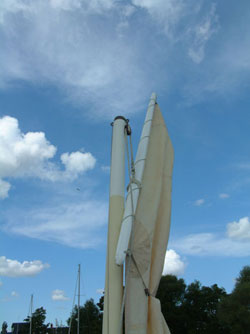
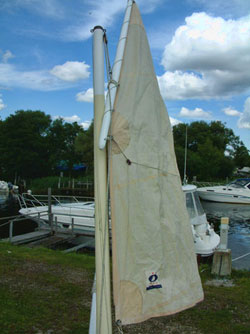
1) How do you set up the mizzen lug sail? Does it just haul up from the throat on the spar on the halyard; or do you set it up like the main with a pulley on the spar and beads around the mast?

2) How do you set up the system for choking the Mizzen (putting it away… sorry…it must have a name!)?

3) A number of people have mentioned problems with knowing when the centreboard is fully down or not. I have the same problem. At the moment I wind it fully up and then wind it down 12 full circles on the winch, it sort of feels right, but any ideas or advice is welcome.

4) I have decided to try using the boat without the outboard this year. So I’m going to get some oars (about 10’long?); and using a ‘strop’ around the winches as rowlocks. Has anyone tried rowing a Romilly? Any advice in setting this up would be welcome.

5) In the same vane as question 4, One reason I want to get rid of my 5hp engine is that it is so big and heavy and I can’t move it easily. Has any one successfully tried a smaller outboard? (smaller than 4hp; say.. 2.5hp?).

Lastly:
6) It would be good to get all the Romillys together one year (say in 2011). I think others must feel the same. If so where and when? Everyone would be most welcome down here on the River Dart! What does everyone think? Any ideas welcome!

Kind regards

Simon Ellyatt
    1. David Collin says:

      1. When hoisting the mizzen, no tackle is needed. Use the halyard to bring the mizzen yard as close as possible to the sheave at the masthead, then cleat it. Use a lashing (I suggest three or four part) to secure the foot to the eye on the deck at the base of the mast, and set it up till the luff is hard.

      2. I have experimented with a lot of different ways of furling the mizzen, but the only one I have found to be simple and snag free, is to use two sail ties round the mast, one at the foot, and another just below the masthead.

      3 I have never experienced difficulty knowing where the centreboard is in terms of ‘up and down’, but my boat may be different from yours. Mine was completed from a kit supplied by Bridgend Boats. It came with a small perspex window in the top of the centreboard case. I quickly decided it was no use, as it was always clouded with condensation. I replaced it with a small sliding wooden lid,(like an old fashioned pencil box) which lets me see at a glance how much cable is on or off the winch. In most situations, it is easy to feel when the centreboard is fully down, as all weight then comes off the winch. I count the turns if I wish to bring it half up, in the knowledge that between 45 and 48 turns of the winch handle are needed to fully raise it. Either your winch is different from mine, or your windward performance is set for a dramatic improvement! Good luck.

      Incidentally, I find it vital to lubricate the cheeks of the winch drum from the ‘window’ several times per season to ensure smooth operation.

      Hope you and others will find this of interest.


    1. Phil Holden says:

      I’ve been looking back at some of the pictures I took before Riant was handed over to me. Rob Dawson rigged the sails so that I could see how to do it.

      Rob rigged the mizzen so that the halyard hooked over the yard. I’m not sure if that was an error or deliberate. I have always rigged it with the halyard straight down the mast and the yard does float away a bit when on starboard tack.

      Here are a couple of pictures that show the mizzen rigged and the lines used to “choke” the sail.


    1. Bill Buchholz says:

      Regarding the mizzen, I believe the term we are searching for is “brail”, as in brailed up. I raise and lower the mizzen like any other sail and lash it and the yard around the boomkin. It’s quick and neat. The tack lashing it left alone and all tension comes from the halyard. Less gear and also very quick. I must say I don’t envy you guys with centerboard winches: 45 cranks! Mine is a 3-1 tackle so it comes up in less than a second. A nice feature when you find yourself over a rocky ledge.
      We row ours with 9’ oars stowed under the side decks. The oarlocks are on the bulwark cap rail. I suspect that it will be hard to have your “oarlocks” on the coaming as your gearing will be too high, especially with ten foot oars. We can row along easily at a couple of knots; longest row about three miles. The beauty of the boat is that she sails in such light air that you’ll be moving under sail until there is absolutely no air movement. She also short tacks well, so getting through tight places if it is blowing is very easy. I applaud your dumping of the motor!


    1. Jonnie Taylor says:

      Hello everyone. My wife, Dee, and proud new owners of Romilly 24 (Bridgend built). Thanks for all your comments – really helpful to Romilly newcomers.

      On the subject of oars, we’e fitting a single sculling oar 10’6” long stowed under the sidedeck with a sculling rowlock on the port transom. We’ll let you know how we get on with it.

      The thought of lugging an outboard and its trunking ijn and out everyone time we go sailing does not appeal. The previous owner left it down the whole season (and antifouled it). Because of this, and for environmental reasons, I’m thinking of fitting an electric outboard. It seems that a Romilly will need about 750watts of power which seems to point to a 24v system. The required batteries would possibly act as ballast. Any thoughts?

      Are there any other Romilly owners within reach of the Fal? We would really appreciate the chance for a chat to learn more about sailing, and cruising, this beauty of a boat.

      I have asked Concord Beheer if it might be possible to beg, buy, borrow or steal their owners manual. At the moment no reply but will keep you posted if anyone’s interested.

      Jonnie


PLEASE SUBMIT YOUR COMMENT BELOW